The Health Equation
The Grocery Master Pantry: the kitchen is a training tool
June 17, 2026 · 14 min
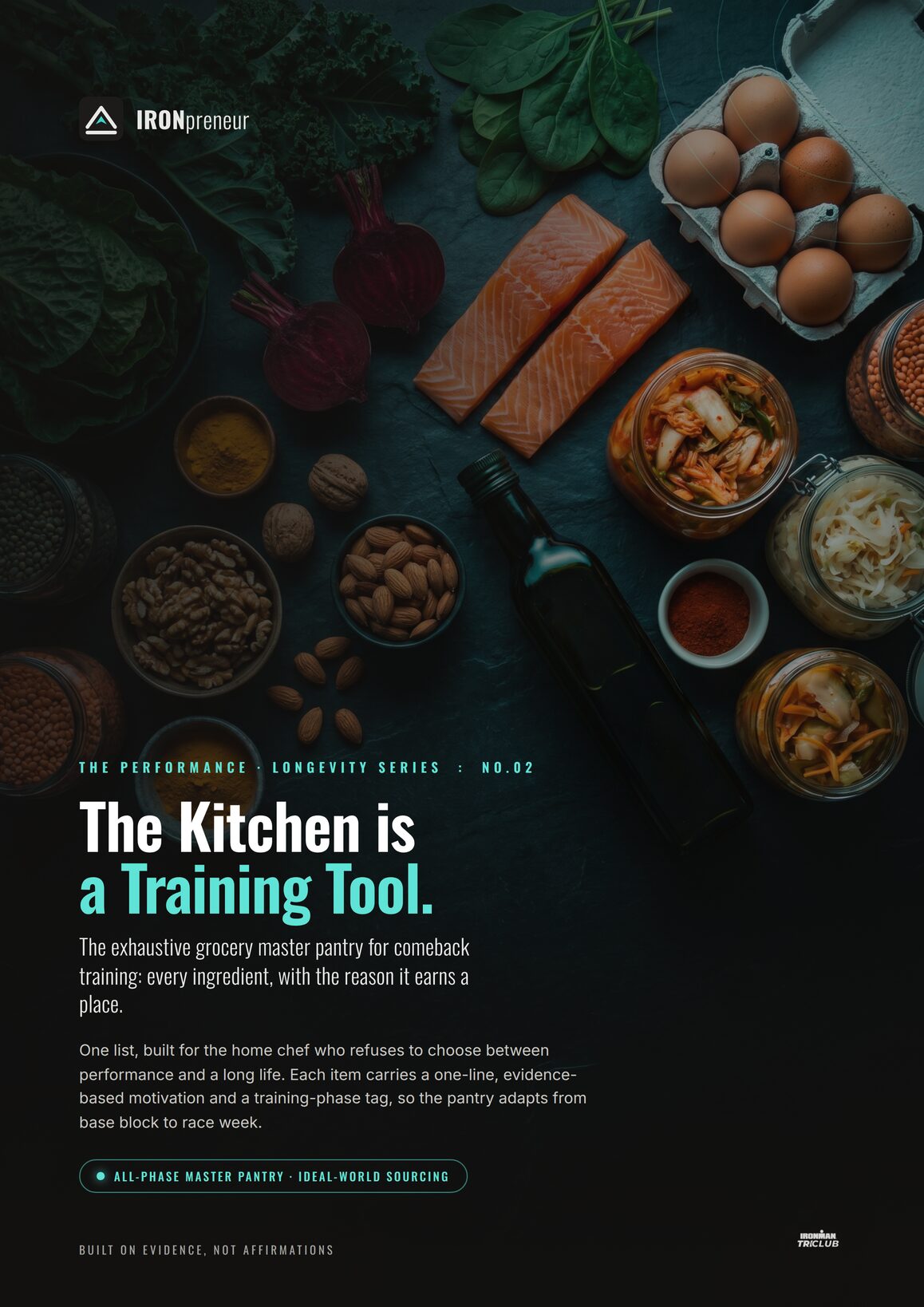
The Performance and Longevity Series, No.02
One list, built for the home chef who refuses to choose between performance and a long life. Each item carries a one-line, evidence-based motivation and a training-phase tag, so the pantry adapts from base block to race week. Built on evidence, not affirmations.
How to use this list
Shop once, adapt by phase
This is a master pantry, not a weekly menu. It assembles the full set of ingredients that lets a home chef build meals with perfectly balanced nutrients across a training year, then tags each item so the cart shifts with the block being trained.
The organizing logic comes straight from the evidence: a Mediterranean dietary base outperforms competing patterns for the combined goal of athletic capacity and a long healthspan, ranking at the top across longevity outcomes in large comparative analyses. On top of that base sit the periodized levers: protein that rises with training load, carbohydrate that scales with volume, and plant bioactives timed to recovery rather than dosed to a maximum.
The premise
Comeback training rewards a stocked kitchen. When the right ingredient is already on the shelf, the balanced meal becomes the default rather than the exception. Stock the system, and good nutrition stops requiring willpower.
Sources: Agarwal, dietary patterns and longevity, BMJ 2023 (PMC10053756). Sourcing assumption is ideal-world availability; diet scope is unrestricted across every food group, herb, spice, fat, ferment, and functional staple.
The phase tags
Four tags steer the cart
Nutrition needs are not constant. The same kitchen serves a low-volume base block and a carbohydrate-loaded race week, but the emphasis moves. Each ingredient is tagged so the shopping list flexes with the training calendar.
| Tag | When it leads | What it signals |
|---|---|---|
| All-Phase | Year-round staple | Foundational to the Mediterranean base; in the kitchen every week regardless of block |
| Base | Base and off-season | Plant-forward, longevity-leaning emphasis: opens IGF-1 cycling and autophagy windows |
| Build / Peak | High-volume and intensity | Anabolic and recovery emphasis: protein, leucine, and antioxidant repair scale up |
| Race Week | Taper and competition | Fueling-specific: rapid carbohydrate, nitrate loading, gut-friendly low-residue choices |
The reading rule
An All-Phase tag means buy it every week. A phase tag means lean into it during that block and ease off in others. The kitchen stays stocked; the plate composition shifts. Target zones beat maximums: omega-3 above 1.5 g/day raises atrial-fibrillation odds, and chronic high-dose antioxidant supplements blunt training adaptation.
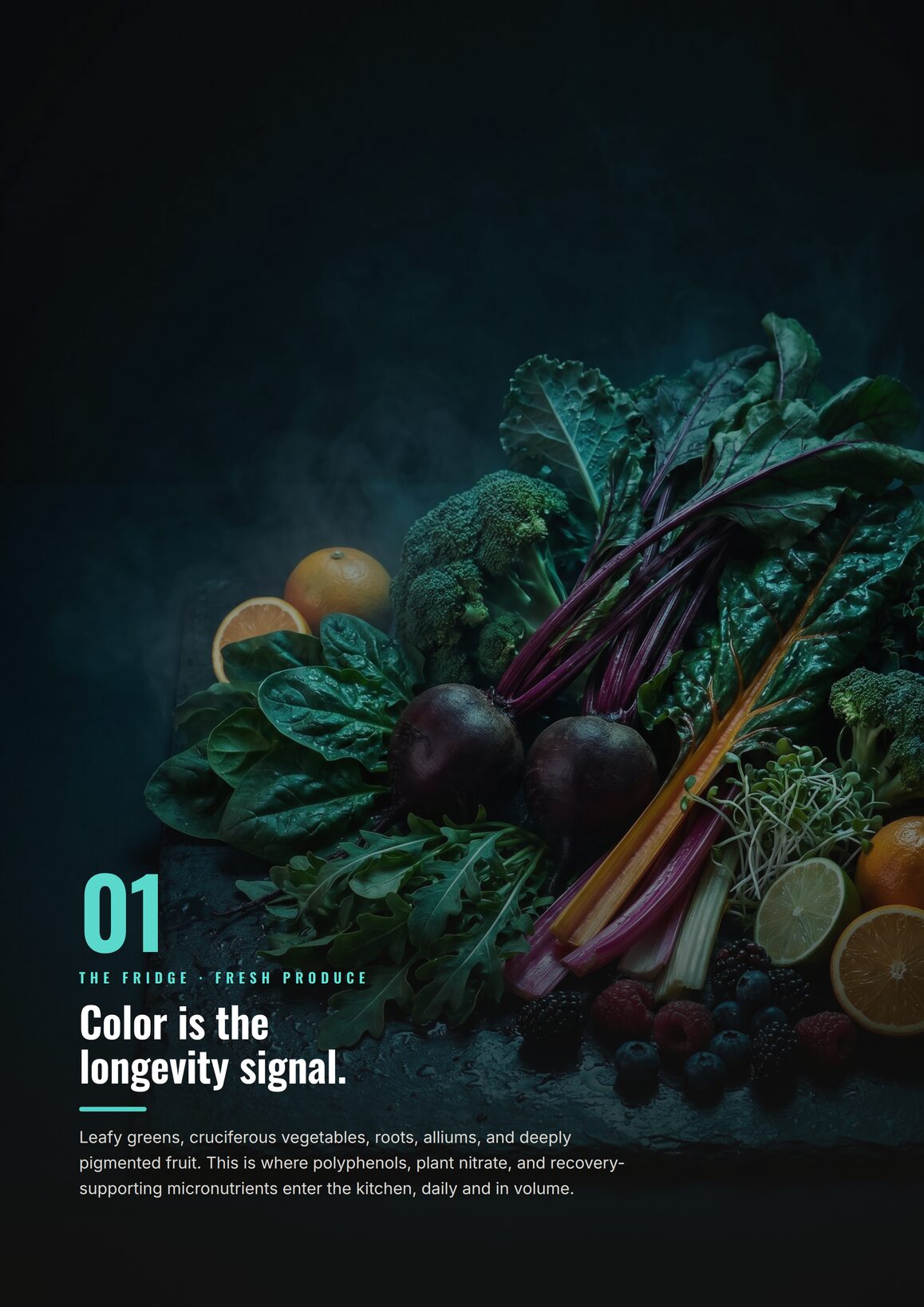
01 . The fridge, fresh produce
Color is the longevity signal
Leafy greens, cruciferous vegetables, roots, alliums, and deeply pigmented fruit. This is where polyphenols, plant nitrate, and recovery-supporting micronutrients enter the kitchen, daily and in volume.
Leafy greens and salad base
- Spinach (All-Phase): high plant-sourced nitrate (HR 0.83 for all-cause mortality versus animal nitrate at 1.09); folate and magnesium for recovery.
- Rocket or arugula (All-Phase): among the densest dietary nitrate sources; supports the 60 to 141 mg/day habitual intake that improves vascular function.
- Swiss chard and beet greens (Base): nitrate plus magnesium and potassium; the whole beet plant earns its place, leaves included.
- Romaine and mixed lettuce (All-Phase): everyday salad volume; fibre and water for satiety and gut transit without caloric cost.
- Watercress (Base): high nutrient density per calorie; nitrate and vitamin C in a peppery base green.
Cruciferous and sulforaphane
- Broccoli (All-Phase): sulforaphane precursor; activates the Nrf2 pathway that upregulates endogenous antioxidant defence in masters athletes.
- Broccoli sprouts (Peak): the most concentrated sulforaphane source by far; a small handful rivals a head of broccoli for Nrf2 activation.
- Kale (All-Phase): vitamin K, lutein, and glucosinolates; sturdy enough for daily volume cooked or raw.
- Cauliflower (Base): versatile cruciferous carbohydrate base; glucosinolates with a milder profile for everyday cooking.
- Brussels sprouts (Base): dense glucosinolate and fibre source; supports the cruciferous target of several servings weekly.
- Bok choy and Asian greens (All-Phase): cruciferous nutrition suited to the Singapore kitchen; calcium and vitamin C with quick cooking.
Nitrate root and performance vegetable
- Beetroot, whole (Race Week): the signature ergogenic vegetable; nitrate to nitrite to nitric oxide improves oxygen economy, loaded 2 to 3 h pre-competition.
Sources: Bondonno 2024, nitrate by source (PubMed 38802612); sulforaphane and Nrf2 in masters athletes, 2024 (PMC12972497).
01 . The fridge, fresh produce (continued)
Roots, alliums, and pigment
Starchy roots and everyday vegetables
- Sweet potato (All-Phase): low-glycaemic whole-food carbohydrate with beta-carotene and potassium; a base-phase fueling staple.
- Potatoes (Peak): high-satiety carbohydrate and potassium; an easily digested glycogen source for the build block.
- Carrots (All-Phase): beta-carotene and fibre; an everyday raw and cooked vegetable for colour and micronutrients.
- Pumpkin and winter squash (Base): beta-carotene and gentle carbohydrate; pairs whole-food fuel with antioxidant pigment.
- Tomatoes (All-Phase): lycopene, a heat-stable antioxidant more bioavailable when cooked; a Mediterranean-base anchor.
- Bell peppers (All-Phase): exceptional vitamin C density supporting iron absorption and collagen synthesis for connective-tissue repair.
- Mushrooms (All-Phase): beta-glucans for immune modulation; UV-exposed varieties add vitamin D to the plate.
Alliums
- Garlic (All-Phase): allicin and organosulfur compounds with cardiovascular and anti-inflammatory effects; a flavour base in nearly every dish.
- Onions and shallots (All-Phase): quercetin, a flavonoid linked to anti-inflammatory and modest endurance benefits; foundational aromatics.
- Spring onions and leeks (All-Phase): allium nutrition with prebiotic inulin fibre that feeds short-chain-fatty-acid-producing gut bacteria.
Pigmented fruit and berries
- Tart cherries (Peak): anthocyanins shown to reduce exercise-induced inflammation and muscle soreness; periodize to recovery, not chronic intake.
- Mixed berries (All-Phase): blueberries, raspberries, blackberries: dense anthocyanins and low-glycaemic fibre for daily polyphenol load.
- Bananas (Race Week): rapid potassium and easily digested carbohydrate; the classic gut-friendly pre- and intra-session fruit.
- Citrus, oranges and lemons (All-Phase): vitamin C and flavonoids; lemon doubles as a flavour and electrolyte-drink base for hydration.
- Pomegranate (Base): ellagitannins that gut bacteria convert to urolithin A, linked to mitochondrial and muscle-quality benefits.
- Kiwi and tropical fruit (All-Phase): vitamin C and actinidin; locally abundant, supports daily fruit variety and digestive comfort.
Sources: tart-cherry anthocyanin recovery trials; plant-nitrate mortality data, Bondonno 2024 (PubMed 38802612); Mediterranean-pattern polyphenol evidence, Agarwal 2023 (PMC10053756).

02 . The fridge, proteins
The signal you periodize
Protein is the highest-leverage lever and the one where age flips the recommendation. The periodized band runs 1.6 to 2.0 g/kg through peak training and 1.2 to 1.4 g/kg in base, with leucine of 3 to 3.5 g per meal for masters athletes 50 to 65 and 3 to 4 g past 70 to overcome anabolic resistance. Past 70, higher protein turns net protective (mortality HR 0.44).
Fatty fish and seafood
- Salmon (All-Phase): complete protein plus EPA and DHA toward the Omega-3 Index 8% target; 2 to 3 servings of fatty fish weekly.
- Sardines (All-Phase): omega-3, calcium from edible bones, and vitamin D in one inexpensive, sustainable tin or fresh fillet.
- Mackerel (All-Phase): among the richest EPA and DHA sources; supports the 1.4 to 2.0 g/day intake without resorting to megadose supplements.
- White fish, snapper and cod (Race Week): lean, highly digestible complete protein; gentle on the gut during taper and race week.
- Shellfish, prawns, mussels, oysters (Peak): highly bioavailable iron, zinc, and B12; oysters are a standout for the ferritin floor of 40 to 50 ng/mL.
Lean meat and poultry
- Chicken and turkey breast (Peak): high-leucine lean protein for the per-meal anabolic threshold; the everyday build-phase workhorse.
- Lean red meat, beef (Peak): heme iron, creatine, and B12 in their most bioavailable form; periodized in, not out, for the masters athlete.
- Eggs (All-Phase): the reference complete protein with choline and the leucine to anchor a meal; year-round across every block.
Sources: Kawasaki, protein protective at 70+ (PMC10413626); omega-3 dose and atrial fibrillation, Shayan (PMC13181205).
02 . The fridge, proteins (continued)
Dairy, plants, and the supplements that work
Dairy and pre-sleep casein
- Greek yogurt (All-Phase): high-leucine casein with live cultures; doubles as protein anchor and gut-microbiome support.
- Milk (All-Phase): whey-plus-casein blend ideal for post-session recovery; calcium toward the 1300 to 1500 mg/day target.
- Cottage cheese or casein-rich cheese (Peak): slow-digesting casein; a 40 g pre-sleep dose supports overnight muscle protein synthesis and repair.
- Cheese, parmesan and feta (All-Phase): concentrated protein and calcium; a Mediterranean-base flavour and nutrient source in modest amounts.
Plant protein and the 30 to 40% target
- Tofu (Base): complete soy protein; shifting 30 to 40% of protein to plants lowers IGF-1 roughly 5 to 10% for the longevity window.
- Tempeh (Base): fermented whole soy, complete protein with probiotics and improved digestibility; a base-phase plant anchor.
- Edamame (Base): whole soybeans delivering complete protein and fibre; an easy plant-forward addition to any meal.
- Lentils and chickpeas (Base): protein with prebiotic fibre and plant iron; central to the legume-forward longevity pattern.
Supplemental protein and anti-sarcopenia stack
- Whey protein powder (Peak): fastest-digesting, highest-leucine protein for the post-session window; closes the per-meal target conveniently.
- Pea or hemp protein (Base): plant powder for base-phase shakes; hemp adds omega-3 while keeping the IGF-1 profile lower.
- Creatine monohydrate (All-Phase): 3 to 5 g/day preserves lean mass and power in masters athletes; among the best-evidenced anti-sarcopenia tools.
Sources: Naghshi, plant protein and mortality HR 0.92, BMJ 2020 (bmj.com/m2412); creatine and HMB anti-sarcopenia evidence in masters athletes.
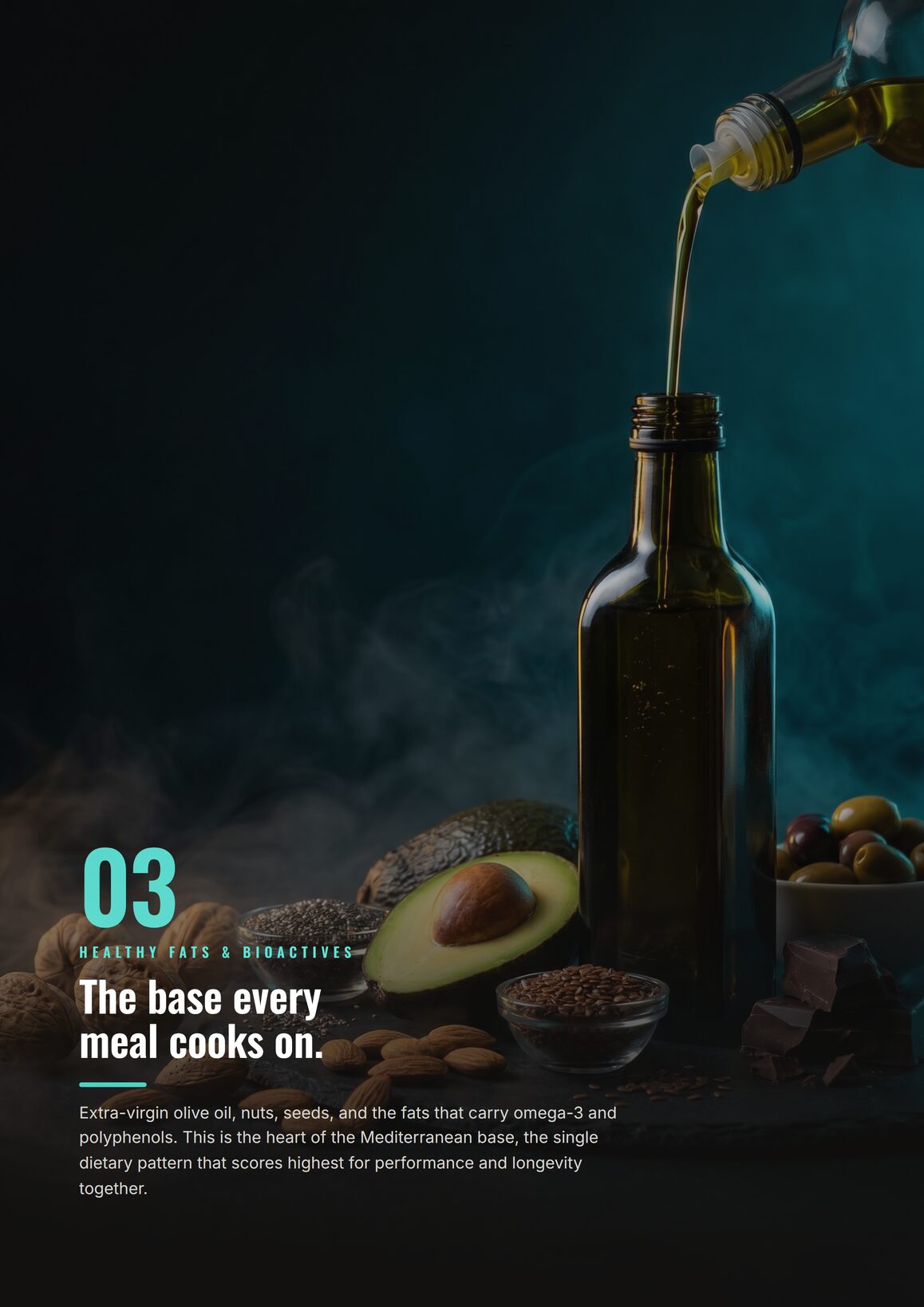
03 . Healthy fats and bioactives
Cook on olive oil, target the zone
Extra-virgin olive oil, nuts, seeds, and the fats that carry omega-3 and polyphenols. This is the heart of the Mediterranean base, the single dietary pattern that scores highest for performance and longevity together.
Cooking and finishing fats
- Extra-virgin olive oil (All-Phase): the Mediterranean-base fat; monounsaturates plus oleocanthal polyphenols with documented anti-inflammatory and longevity associations.
- Avocado and avocado oil (All-Phase): monounsaturated fat, potassium, and a high smoke point; whole avocado adds fibre and satiety.
- Grass-fed butter or ghee (All-Phase): stable saturated fat for high-heat cooking; ghee suits the Singapore kitchen and is lactose-free.
Nuts and seeds
- Walnuts (All-Phase): the leading plant omega-3 (ALA) source; nut consumption is a consistent feature of longevity dietary patterns.
- Almonds (All-Phase): vitamin E, magnesium, and plant protein; a satiating recovery snack that supports the 300 to 400 mg/day magnesium target.
- Chia and flaxseed (All-Phase): plant omega-3 (ALA) plus soluble fibre; flax lignans add a phytoestrogen angle relevant to masters health.
- Pumpkin and sunflower seeds (Base): zinc, magnesium, and vitamin E; easy micronutrient density sprinkled across meals.
- Hemp seeds (Base): complete plant protein with a balanced omega-3 to omega-6 ratio; a base-phase plant-fat staple.
- Nut and seed butters (Peak): calorie-dense fuel for high-volume blocks; almond and peanut butter add quick energy to the build phase.
Polyphenol bioactives
- Dark chocolate, 85%+ (All-Phase): flavanols with vascular and mood benefits; a polyphenol source that earns its place in moderation.
- Green tea and matcha (Base): catechins (EGCG) for metabolic and antioxidant support; time away from training to avoid blunting adaptation.
- Extra-dark olives (All-Phase): whole-food polyphenols and monounsaturated fat; a Mediterranean snack and salad component.
The ceiling to respect
Beyond 1.5 g/day EPA and DHA, atrial-fibrillation odds rise (OR 1.48). Avoid chronic high-dose vitamin C (above 1000 mg) and vitamin E (above 235 IU) around training: they blunt the adaptive signal. Reach the targets through food.
Sources: omega-3 and AF dose, Shayan (PMC13181205); Mediterranean pattern, Agarwal 2023 (PMC10053756); antioxidant-blunting training-adaptation literature.
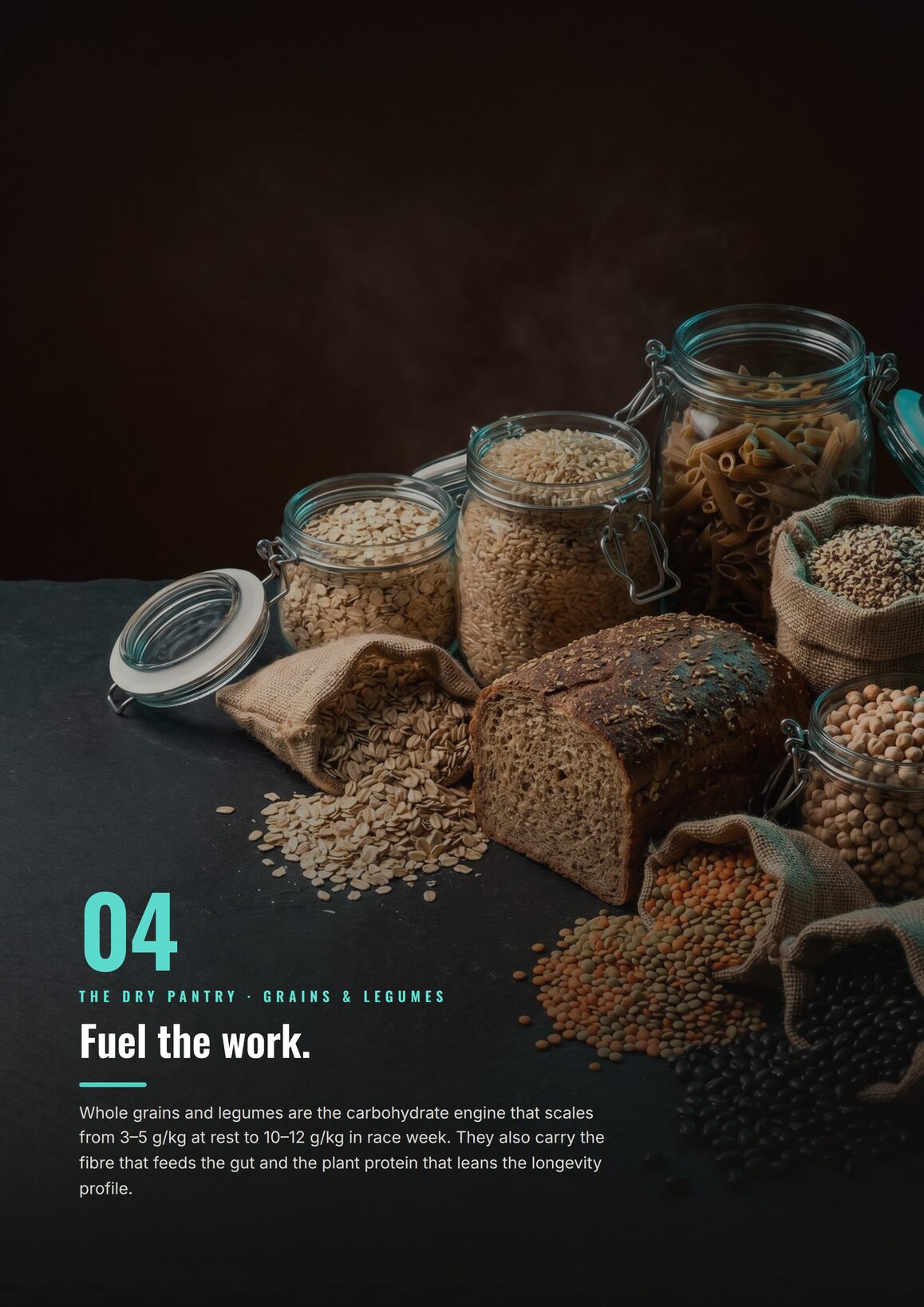
04 . The dry pantry, grains and legumes
Carbohydrate that scales
Whole grains and legumes are the carbohydrate engine that scales from 3 to 5 g/kg at rest to 10 to 12 g/kg in race week. Carbohydrate is periodized from 3 to 5 g/kg at rest to 6 to 10 g/kg in high-volume blocks. Chronic restriction is counterproductive: the lowest-carbohydrate quartile carried plus 5.65 years of biological age.
Whole grains
- Rolled and steel-cut oats (All-Phase): beta-glucan fibre with sustained-release carbohydrate; the everyday pre-training breakfast base.
- Brown and wholegrain rice (Peak): reliable gluten-free glycogen fuel; a high-volume staple that fits the Singapore kitchen.
- White rice (Race Week): low-residue, fast-digesting carbohydrate for race week and carbohydrate loading when gut comfort matters most.
- Quinoa (All-Phase): a complete-protein pseudograin with magnesium and iron; bridges the grain and protein roles.
- Wholegrain and sourdough bread (All-Phase): fermented sourdough improves digestibility and glycaemic response; everyday fuel with gut benefits.
- Wholegrain and white pasta (Peak): wholegrain for base-phase fibre; white pasta for the classic race-week carbohydrate load.
- Buckwheat and barley (Base): rotational whole grains adding rutin and beta-glucan; diversify the carbohydrate and fibre base.
Legumes and pulses
- Lentils, red, green, brown (Base): plant protein, iron, and prebiotic fibre; a longevity-pattern cornerstone and base-phase protein lean.
- Chickpeas (Base): versatile protein and fibre; supports the 30 to 40% plant-protein target and feeds gut bacteria.
- Black and kidney beans (Base): anthocyanin-rich beans pairing plant protein with polyphenols; fibre for short-chain fatty acid production.
- Dried and canned soybeans (Base): complete plant protein for base-phase IGF-1 moderation; the most protein-dense legume.
Functional dry staples
- Canned tomatoes and passata (All-Phase): cooked-lycopene base for sauces; a Mediterranean staple with year-round convenience.
- Honey and maple syrup (Race Week): whole-food rapid carbohydrate for intra-session fuel and natural sweetening; race-week energy.
- Nori and seaweed (All-Phase): iodine for thyroid and metabolic health, plus umami; an easy micronutrient and flavour staple.
Sources: low-carbohydrate biological-age data, Zheng 2025 (PubMed 41108793); IOC carbohydrate-periodization consensus; legume-forward longevity-pattern evidence.
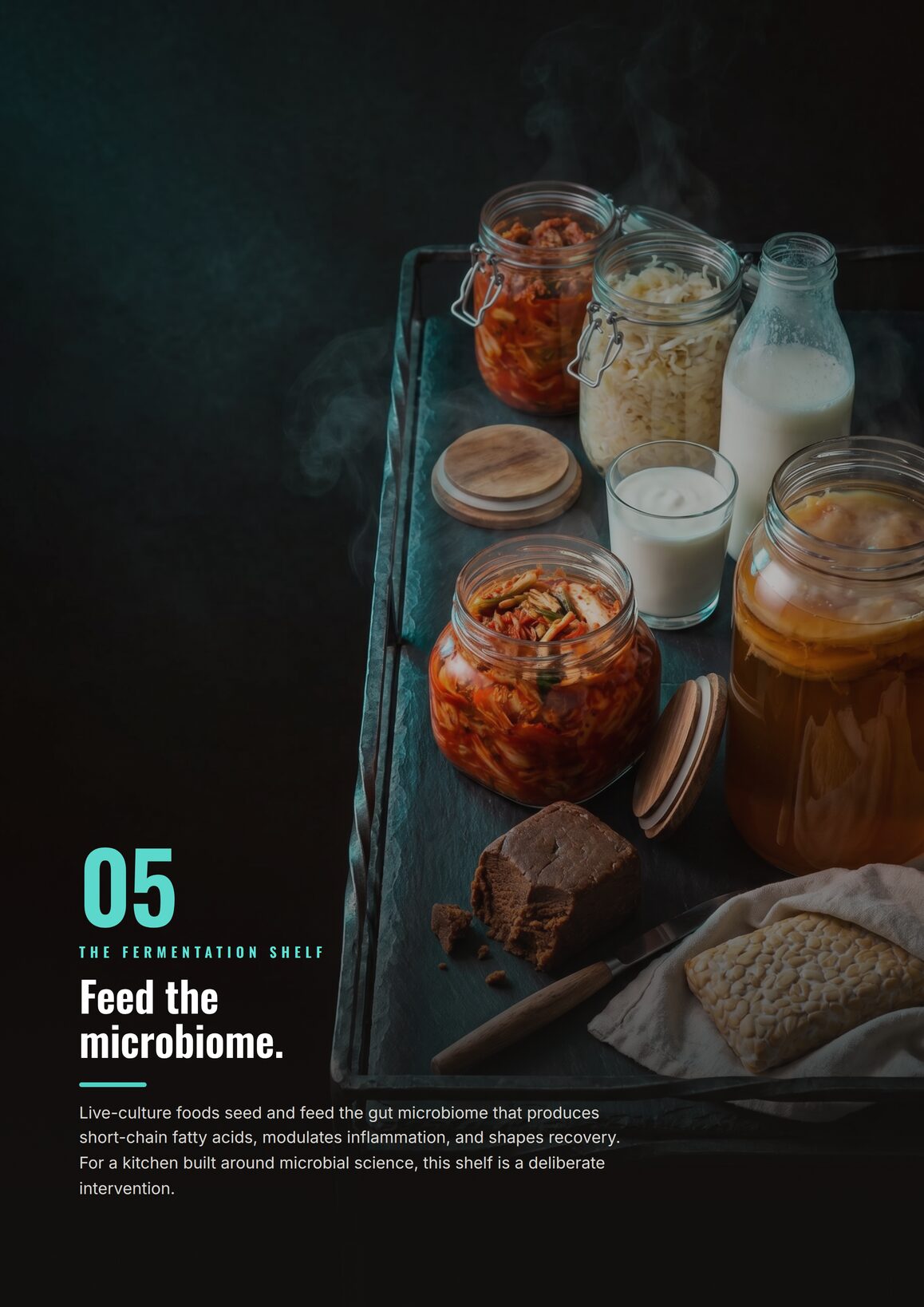
05 . The fermentation shelf
Live cultures, daily
Regular intake of fermented foods increases microbiome diversity and lowers inflammatory markers; the short-chain fatty acids these microbes produce support gut-barrier integrity, immune regulation, and recovery from training load. For a kitchen built around microbial science, this shelf is a deliberate intervention. Variety matters more than volume.
Vegetable ferments
- Kimchi (All-Phase): lacto-fermented vegetables delivering diverse probiotic strains plus the nitrate and fibre of the base vegetables.
- Sauerkraut (All-Phase): live-culture cabbage with vitamin C and fibre; an easy daily source of fermentation diversity.
- Fermented pickles, brined (Peak): brine-fermented, not vinegar-pickled, vegetables add live cultures and electrolytes; sodium for the salty sweater.
Dairy and cultured ferments
- Kefir (All-Phase): the most strain-diverse fermented dairy; probiotics with complete protein and calcium in a drinkable form.
- Live-culture yogurt (All-Phase): probiotic cultures plus high-leucine casein; bridges the protein and microbiome roles in one food.
Soy and specialty ferments
- Miso (All-Phase): fermented soy paste with probiotics and deep umami; a flavour base that adds microbiome benefit to soups and dressings.
- Tempeh (Base): fermented whole soybean, complete plant protein with probiotics and superior digestibility to unfermented soy.
- Natto (Base): the richest dietary source of vitamin K2 (MK-7), directing calcium to bone; supports masters bone health.
- Kombucha (All-Phase): fermented tea with organic acids and live cultures; a low-sugar hydration alternative with gut benefit.
- Apple cider vinegar, with mother (Base): live-culture acetic acid that may blunt post-meal glucose spikes; a functional dressing and marinade base.
The diversity principle
Rotating several different ferments beats megadosing one. A varied fermentation shelf builds a more resilient, diverse microbiome than any single probiotic supplement, and it does so through food the body already knows how to use.
Sources: fermented-food microbiome-diversity and inflammation trials; short-chain fatty acid and gut-barrier literature; vitamin K2 and bone-health evidence.
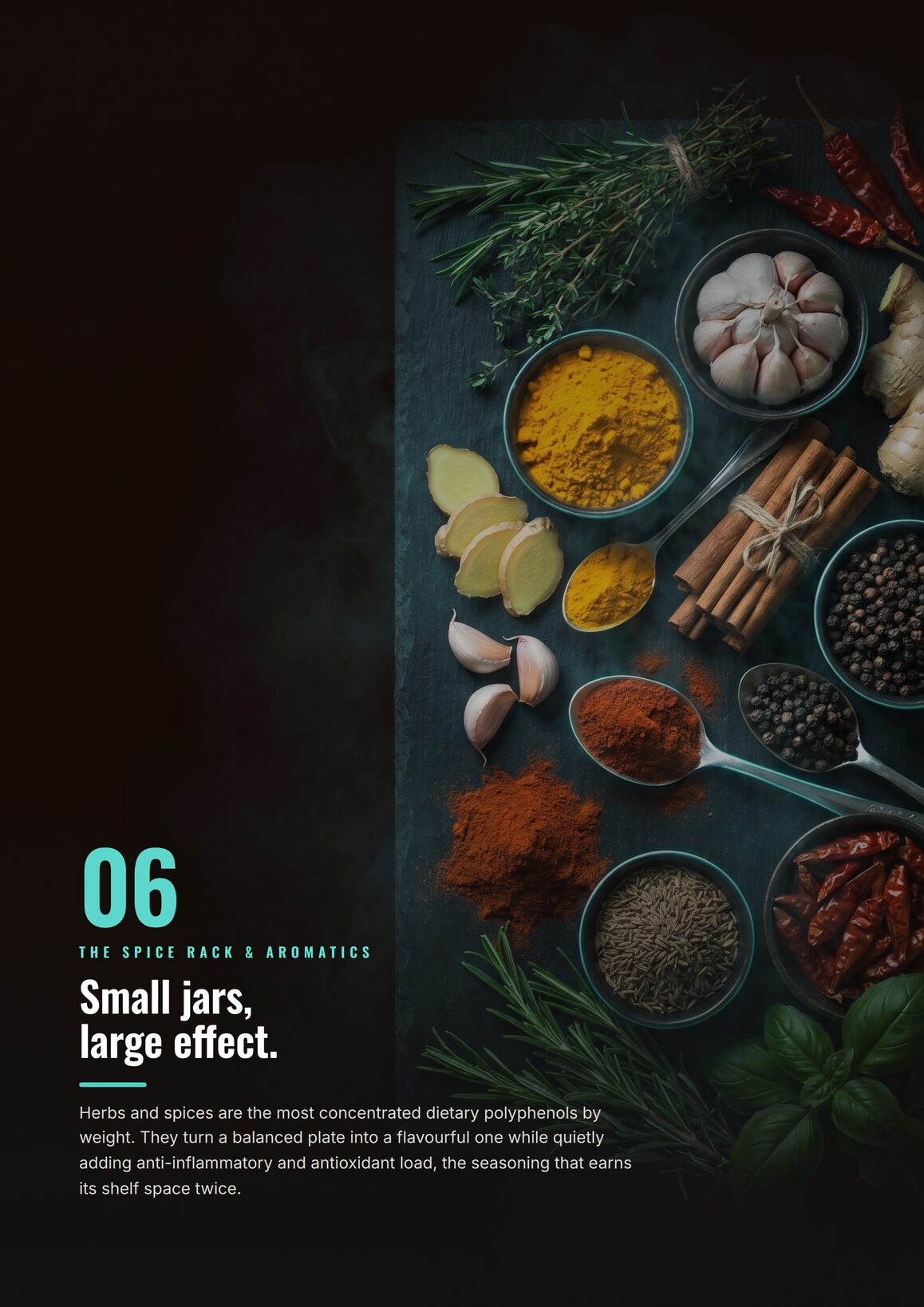
06 . The spice rack and aromatics
Season for flavour and function
Herbs and spices are the most concentrated dietary polyphenols by weight. They turn a balanced plate into a flavourful one while quietly adding anti-inflammatory and antioxidant load, the seasoning that earns its shelf space twice.
Anti-inflammatory powerhouses
- Turmeric (Peak): curcumin with anti-inflammatory effects on exercise-induced soreness; pair with black pepper for absorption.
- Ginger, fresh and ground (All-Phase): gingerols that ease muscle soreness and settle the gut; doubles as a race-week anti-nausea aromatic.
- Black pepper (All-Phase): piperine boosts curcumin bioavailability up to twentyfold; the essential partner to turmeric.
- Cinnamon (All-Phase): polyphenols with favourable effects on glucose handling; warms whole-food carbohydrate dishes.
- Cayenne and chilli (All-Phase): capsaicin with metabolic and circulatory effects; central to the Singapore flavour base.
Fresh herbs
- Basil and coriander (All-Phase): polyphenol-rich finishing herbs that add flavour without sodium; coriander suits Asian cooking year-round.
- Rosemary and thyme (All-Phase): carnosic acid and thymol antioxidants stable under heat; Mediterranean-base roasting and braising herbs.
- Parsley and mint (All-Phase): vitamin K, chlorophyll, and digestive support; brighten dishes and aid gut comfort.
- Oregano (All-Phase): one of the highest antioxidant capacities per gram of any herb; a potent dried-pantry polyphenol.
Warming spices and functional seasoning
- Cumin and coriander seed (All-Phase): foundational ground spices with iron and antioxidant content; build the base of curries and rubs.
- Smoked and sweet paprika (All-Phase): carotenoid pigments and depth of flavour; antioxidant colour without added fat or salt.
- Cardamom, cloves, star anise (Base): high-polyphenol warming spices for variety; broaden the antioxidant and flavour palette across cuisines.
- Sea salt and iodised salt (Peak): sodium for electrolyte balance in heavy sweating; iodised salt covers the thyroid micronutrient base.
- Soy sauce, tamari and fish sauce (All-Phase): umami and sodium for the Asian kitchen; fermented varieties add depth and gut-friendly cultures.
Sources: curcumin and ginger exercise-recovery trials; piperine bioavailability data; herb and spice antioxidant-capacity rankings.

07 . Hydration and race fueling
Fuel scales with a trained gut
Race day is where the performance case is least ambiguous and most trainable. The gut is the bottleneck, and the gut adapts. Intra-race carbohydrate runs 60 to 90 g/hour for age-groupers and up to 90 to 120 g/hour for gut-trained athletes, using a 2:1 glucose-to-fructose ratio past the 90 g/hour gate.
Carbohydrate fuel
- Energy gels and chews (Race Week): concentrated rapid carbohydrate for the 60 to 120 g/hour target; rehearse them in training, never debut on race day.
- Drink-mix carbohydrate powder (Peak): a 2:1 glucose-to-fructose mix raises absorption past the single-transporter ceiling; the tool for gut-training above 90 g/hour.
- Dates and dried fruit (Race Week): whole-food rapid carbohydrate with potassium; a natural gel alternative for long sessions.
Electrolytes and hydration
- Electrolyte powder or tablets (Peak): sodium-led replacement for heavy sweating in the Singapore heat; the salty-sweater's defence against hyponatraemia and cramp.
- Coconut water (All-Phase): natural potassium and light carbohydrate; a whole-food rehydration option for everyday training.
- Sea salt, fueling use (Peak): added to fluids for long, hot sessions; the cheapest and most reliable sodium source for sweat replacement.
Nitrate and recovery concentrates
- Beetroot juice or concentrate (Race Week): concentrated nitrate (5 to 9 mmol) 2 to 3 h pre-competition improves oxygen economy and time-trial performance.
- Tart cherry concentrate (Peak): anthocyanin dose (around 480 mg, twice daily) periodized to hard blocks reduces soreness and supports sleep recovery.
- Coffee and caffeine source (Race Week): caffeine is among the best-evidenced ergogenic aids; a strategic pre-session and race tool, used to a plan.
The discipline
Carbohydrate periodization beats chronic restriction, and a trained gut beats a brave one. Rehearse every fueling product in training. The 90 g/hour gate opens through weeks of practice, never a race-day decision.
Sources: IOC carbohydrate-during-exercise consensus; nitrate and performance evidence, Bondonno 2024 (PubMed 38802612); tart-cherry and caffeine ergogenic trials.
The freezer and micronutrient insurance
The backup that never spoils
The freezer keeps nutrient density on hand when fresh runs out, and a short list of monitored micronutrients closes the gaps that food alone can leave. These are the staples that keep the system running on a busy training week.
Freezer staples
- Frozen mixed berries (All-Phase): flash-frozen at peak ripeness; anthocyanins retained for year-round smoothies and recovery bowls.
- Frozen spinach and greens (All-Phase): nitrate and folate on standby; convenient volume for any meal when fresh greens run low.
- Frozen wild fish fillets (All-Phase): omega-3 insurance between fresh-fish purchases; keeps the 2 to 3 servings weekly achievable.
- Frozen edamame and peas (Base): quick plant protein and fibre; an instant base-phase addition with no preparation.
- Frozen banana and mango (Peak): ready carbohydrate for smoothies and recovery shakes; convenience fuel for the build block.
Monitored micronutrient insurance, test then supplement to target
- Vitamin D3 (All-Phase): target 40 to 60 ng/mL (2000 to 4000 IU/day); supports bone, immune, and muscle function where sun and diet fall short.
- Magnesium, glycinate or citrate (All-Phase): 300 to 400 mg/day for muscle function and sleep; choose glycinate or citrate, not poorly absorbed oxide.
- Iron, if ferritin low (Peak): hold ferritin above 40 to 50 ng/mL; take on waking pre-training while hepcidin is low for best absorption.
- Omega-3 (EPA and DHA) capsules (All-Phase): tops up the Omega-3 Index to 8% when fish intake dips; keep total intake at or below 1.5 g/day.
- Calcium source, if needed (Base): toward 1300 to 1500 mg/day from dairy and greens first; supplement only to close a measured dietary gap.
Sources: vitamin D, iron, and magnesium athlete-status thresholds; hepcidin-timing iron-absorption evidence; omega-3 ceiling, Shayan (PMC13181205). Test before supplementing.
The phase shopping matrix
One pantry, four shopping modes
The full list never changes, but the emphasis does. This matrix turns the tagged ingredients into a quick mode for each block: what to load into the cart heavily, and what to ease back, as the training calendar turns.
| Phase | Lead with | Ease back |
|---|---|---|
| Base / Off-season | Legumes, tofu, tempeh, plant proteins, whole grains, leafy greens, ferments, green tea, pomegranate | Race-week refined carbohydrate, gels, beetroot loading |
| Build / Peak | Whey, lean meat, poultry, eggs, casein, white rice and pasta, tart cherry, turmeric, electrolytes, creatine | Heavy plant-protein substitution; chronic restriction of any kind |
| Race Week | White rice, pasta, honey, dates, bananas, gels and chews, beetroot juice, electrolytes, low-residue white fish, caffeine | High-fibre legumes and cruciferous volume, high-fat meals, anything untested |
| All-Phase base | Olive oil, fatty fish, vegetables, nuts, seeds, eggs, yogurt, kefir, ferments, herbs and spices, vitamin D | Nothing: this base anchors every week |
The single rule
Keep the Mediterranean base stocked year-round, then move within the band by phase. Match protein and carbohydrate to training demand instead of chronically maximizing or suppressing either one.
Sources: Agarwal 2023, Mediterranean pattern (PMC10053756); ISSN protein position stands; IOC carbohydrate-periodization consensus; Zheng 2025, low-carbohydrate biological age (PubMed 41108793).
The bottom line
Stock the kitchen, forge the comeback, refuse to choose
- The Mediterranean base is non-negotiable. Olive oil, fatty fish, vegetables, legumes, whole grains, nuts, and ferments anchor every phase, every week.
- Periodize the levers, not the base. Protein rises with training load, carbohydrate scales with volume, and plant emphasis opens the longevity windows in base.
- Target zones beat maximums. Omega-3 to an 8% index, not a megadose; antioxidants from food timed to recovery, not chronic high-dose pills.
- Feed the microbiome and the gut. A diverse fermentation shelf and a trained gut do as much for resilience and race-day fueling as any single food.
A stocked, evidence-built kitchen makes the balanced meal the path of least resistance. The discipline that forges the body is the discipline that scales the company. The fittest founders win.
Colophon and sources
Method and selected sources
This master pantry translates the companion performance-and-longevity synthesis into an ingredient checklist, organized by storage zone and tagged by training phase. Motivations are grounded in post-2023 peer-reviewed literature, prioritizing systematic reviews, meta-analyses, RCTs, and IOC, ACSM, and ISSN consensus statements, anchored against foundational sources. This is nutritional guidance, not medical advice; individual targets, especially supplemental iron, vitamin D, and omega-3, should be set with testing and a sports-medicine physician or dietitian familiar with masters-athlete physiology.
Selected sources: Agarwal et al., dietary patterns and longevity, BMJ 2023 (PMC10053756); Naghshi et al., plant protein and mortality, BMJ 2020 (bmj.com/m2412); Kawasaki et al., protein protective at 70+ (PMC10413626); Bondonno et al., nitrate by source, 2024 (PubMed 38802612); Shayan et al., omega-3 dose and atrial fibrillation (PMC13181205); Zheng et al., low-carbohydrate and biological age, 2025 (PubMed 41108793); sulforaphane and Nrf2 in masters athletes, 2024 (PMC12972497); IronPreneur No.01, Performance and Longevity synthesis (companion edition). Prepared June 2026. Built on evidence, not affirmations.
Want the room where this gets put into practice?